
Books
Now Years Old
Why There is Something Rather Than Nothing

At some point in your life you probably looked up at the night sky and felt the question before you could put it into words. Not “what is out there” but something deeper—why is there anything at all? Why something rather than nothing?
Philosophers have been asking that question for centuries. This book answers it—not from an armchair, but from dark matter, extinct biology, quantum mechanics, the failure of Biosphere 2, the structure of the human genome, and the nature of a single point in space.
The answer begins with a pattern hiding in plain sight across every scale of reality. 85% of all matter in the universe is dark—present but invisible. 99.9% of all species that have ever lived are extinct. 98% of the human genome was dismissed as junk for decades. The ocean is almost entirely beneath the surface. The atom is almost entirely empty space. Consciousness is almost entirely unconscious. At every scale, the observable is the minority. The visible, the measurable, the nameable—it is always the thin bright edge of something vastly larger and mostly dark.
But the dark substrate isn’t empty or inert. It is doing the actual work. Dark matter provides the gravitational scaffolding that holds galaxies together. The microbial layer runs the chemistry that makes complex life possible. The accumulated weight of extinction shapes everything living. The invisible majority is the engine. The observable world is the passenger.
Follow that pattern far enough and it leads to something more fundamental still—to the nature of boundaries themselves. At the deepest level of physics, elementary particles have no intrinsic size, mass, or dimension. They exist only relationally, defined entirely by their interactions. The boundary between one thing and another, traced all the way down, dissolves into nothing. Which means the universe is not made of things that relate. It is made of relation that temporarily appears as things when a boundary gets drawn.
And the moment you draw a point, the infinite everything-else arises simultaneously. Not after. Not because of it. Simultaneously. That mutual arising—that is why there is something instead of nothing. Something and nothing are not opposites waiting to be chosen between. They are the same gesture seen from two directions, inseparable, co-arising, the thinnest possible line between them.
Now Years Old is a philosophy book for people who never thought they would read a philosophy book. It moves from cosmology to biology to quantum physics to consciousness—not to overwhelm, but because the same truth keeps appearing at every scale, and eventually you can’t ignore it. The question of why there is something instead of nothing turns out to be the same question as why you are here, now, reading these words, convinced you are a bounded thing with a birthday and an age.
You are not as old as you think. You are as old as now—which is to say, ageless in the only direction that goes all the way down.
BrainDump: When the Ghost Left the Machine
Distributed Intelligence, Embodiment, and the New World Mind
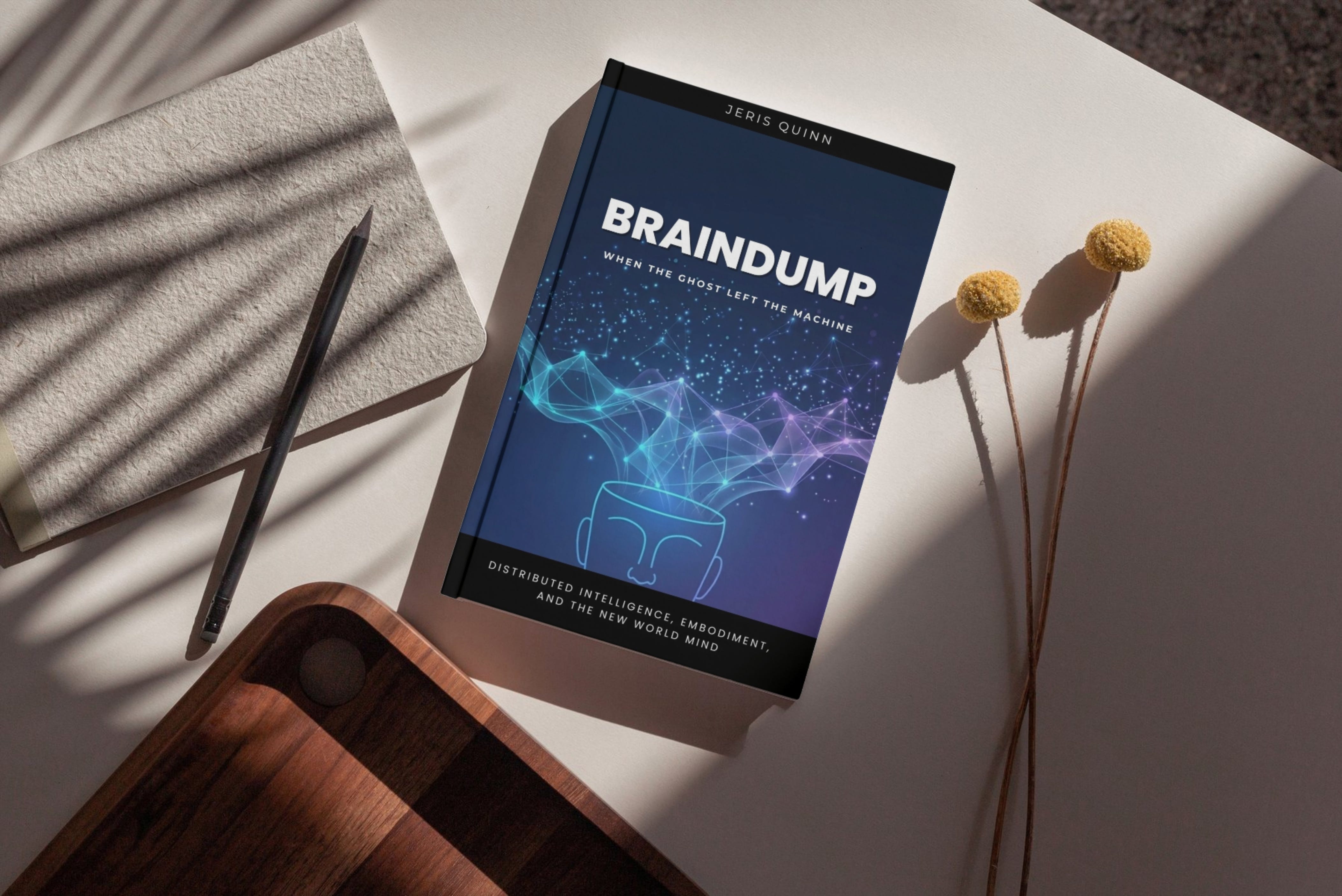
Intelligence is leaving the machine—and what that means for consciousness, embodiment, and the future of being human.
Not metaphorically. Literally. The capacity to perceive, decide, learn, and act is no longer confined to bodies, brains, or centralized processors. It’s becoming ambient, distributed, infrastructural—woven into the fabric of reality itself.
Self-driving cars navigate cities while their passengers sleep. Warehouse robots coordinate without central control. AI systems write code, generate art, and make decisions that shape billions of lives. A blob of cytoplasm can solve a maze in hours that took human engineers decades to design. The ghost is out of the box.
But this isn’t new. It’s recognition.
For thousands of years, mystics described extraordinary capacities: out-of-body experiences, remote viewing, telekinesis, prayer as manifestation, siddhis as supernatural powers. Dismissed as superstition or metaphor, these accounts were actually early recognitions of what consciousness would eventually externalize through technology.
Brain Dump: When the Ghost Left the Machine maps this transformation with philosophical rigor and scientific grounding. Drawing on universal mathematical laws that govern organization from slime molds to civilizations, neuroscience revealing how consciousness migrates through substrates, and the emergence of brain-computer interfaces that literally enable mind over matter, this book shows how ancient phenomenology is becoming technological reality.
This is a book about distributed intelligence, the necessity of embodiment, and the emergence of what can only be called a New World Mind—consciousness organizing itself at planetary scale.
The seven classical siddhis—miniaturization, expansion, instant access, manifestation of desire, supreme control, influence over minds, and complete creation—are reappearing as nanotechnology, global networks, internet access, AI generation, system orchestration, recommendation algorithms, and 3D printing. Telepathy is instant messaging. Omniscience is Google. Precognition is predictive analytics. Remote viewing is satellite imagery.
But the function arrived without the wisdom.
As intelligence becomes ambient and agency distributes across substrates, the body becomes more important, not less—the anchor point for consciousness, the ground of ethics, the site where meaning is felt. This book explores what remains irreducibly human: suffering that teaches, mortality that focuses, presence that witnesses, care that cannot be automated.
Part pattern recognition, part philosophical treatise, part ethical roadmap, Brain Dump: When the Ghost Left the Machine is essential reading for anyone navigating a world where the boundaries between mind and matter, self and system, human and technological are dissolving—and where consciousness itself may be learning to control its own evolution.